Estimated reading time: 11 minutes
The key to being able to recruit channel partners on LinkedIn efficiently is having a filtered, signal-rich prospect list before you send a single message. Getting partner recruitment outreach right is the difference between a pipeline that fills itself and one that stalls after the first cohort. Building your ideal partner profile SaaS template is the foundation everything else depends on.
The most effective way to recruit channel partners on LinkedIn in 2026 isn’t a single cold DM — it’s a systematic, tool-backed sequence that most SaaS teams never build. That means nailing your partner recruitment outreach before you touch a single LinkedIn filter. You can have the best commission structure and the slickest PRM in the world; if you can’t find and convert the right resellers, referral partners, and VARs, none of it matters.
LinkedIn is still the highest-leverage channel for recruiting channel partners in 2026. But the playbook has changed. Generic connection requests and copy-paste DMs get ignored or flagged. The SaaS teams winning on partner recruitment are combining LinkedIn targeting with AI outreach tools to run systematic, personalized sequences at scale — and filling their partner pipelines in weeks, not quarters.
That’s why channel partner prospecting needs its own dedicated process — separate from your sales motion.
This guide walks you through the exact process: from defining your ideal partner profile to automating outreach and onboarding your first cohort through your PRM.
Updated June 2026. Based on our analysis of SaaS partner programs at the $1M–$20M ARR stage.
Key Takeaways
- Building a strong partner recruitment pipeline is crucial for SaaS programs, and LinkedIn remains the top channel for this in 2026.
- Focus on defining your Ideal Partner Profile (IPP) and use AI-powered prospecting tools for effective outreach.
- Develop a multi-touch outreach sequence that combines LinkedIn and email to engage potential partners.
- Create compelling outreach messages that highlight benefits for potential partners, using tailored templates.
- Onboard recruited partners quickly via a PRM to maintain momentum and drive early engagement.
Every step in this guide flows from a well-built ideal partner profile SaaS programs use to separate high-fit partners from time-wasters.
Why LinkedIn Is the Best Channel for Recruiting Channel Partners
LinkedIn is where your ideal channel partners already live. Agency owners, independent consultants, VARs, and tech resellers use LinkedIn as their primary professional network — and they’re actively looking for new vendor relationships that can diversify their revenue.
Unlike cold email (where you’re fighting deliverability and inbox clutter) or paid ads (where partner intent is hard to target), LinkedIn lets you filter by job title, company size, industry, and even the tools a prospect already uses. A regional IT consultancy already selling adjacent SaaS tools to your exact ICP is three clicks away.
The challenge in 2026 is standing out. LinkedIn’s algorithm is aggressive about flagging bulk outreach, and decision-makers receive dozens of DMs weekly. That’s why this guide focuses on signal-based targeting and AI-assisted personalization — the only approach that moves response rates into double digits.
How to Recruit Channel Partners on LinkedIn in 2026
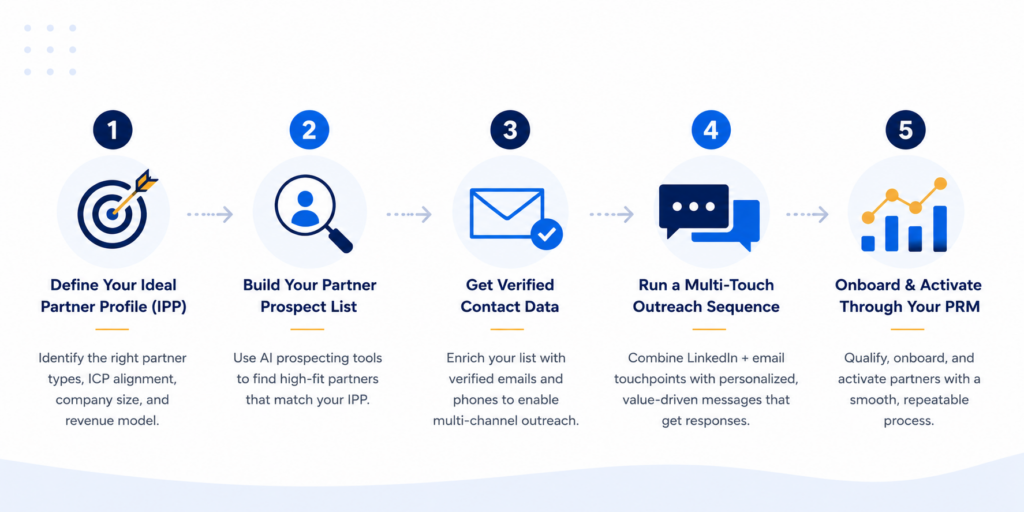
Step 1 — Define Your Ideal Partner Profile (IPP) Before You Touch LinkedIn
The biggest mistake SaaS teams make is skipping the Ideal Partner Profile and going straight to outreach. You end up recruiting dozens of partners who generate zero revenue — and burning your team’s time managing them.
Your IPP should answer four questions:
- Who do they already sell to? Your best partners already serve your target customer. A partner selling project management tools to construction firms is a natural fit for a SaaS product in that vertical.
- What’s their current revenue model? Resellers, referral agents, and integration partners all require different commission structures and enablement investment.
- What size do they need to be? A five-person boutique agency and a 200-person VAR require completely different support levels and deal timelines.
- What geography or vertical do you need them to cover? Don’t recruit generalist partners when you need vertical depth.
Your ideal partner profile SaaS teams rely on shouldn’t be a one-page doc that gets filed away — it should be the filter every LinkedIn prospect gets scored against before outreach begins.
Pro tip: Use the free Channel-sales.ai App to build a structured IPP template in minutes — paste in your product description and ICP, and it outputs a partner qualification framework you can use to score LinkedIn prospects before outreach.
Once your IPP is locked, you’re ready to build a targeted prospect list. Your ideal partner profile SaaS template should be a living document — revisit it after your first 10 partner conversations and tighten the criteria based on who actually converts. Revisit your ideal partner profile SaaS criteria after your first 10 recruits — it will sharpen considerably once you see who actually converts.
Read more: PartnerStack’s guide to building an your IPP framework programs use is a solid starting point for your first draft.
Once your IPP is defined, the next move is building a targeted prospect list.
Manual LinkedIn searches hit limits fast. Boolean search strings help, but they don’t scale — and LinkedIn’s native filters don’t let you cross-reference enough signals to find high-fit partners efficiently.
This is where AI-powered prospecting tools dramatically accelerate the process.
Apollo is the strongest tool in this workflow for SaaS partner recruitment. You can filter by job title (Owner, Founder, Managing Director, VP of Partnerships), industry, company headcount, and technology stack — the last filter being critical. If you sell a HubSpot integration, Apollo lets you find agencies and consultancies that already have HubSpot in their tech stack and are actively selling HubSpot services to your ICP. That’s a warm partner prospect before you’ve sent a single message.
Systematic channel partner prospecting is what separates programs that hit 20 active partners in 90 days from those still recruiting partner number three at month six.
Build a list of 200–400 prospects that match your IPP. Export with verified emails for your outreach sequence (covered in Step 4). Effective channel partner prospecting starts with knowing exactly who you’re looking for before you open Apollo or LinkedIn.
What to look for in a strong LinkedIn partner prospect:
- Job title signals ownership or partnership decision authority (Founder, Owner, Director, Head of Partnerships)
- Company has 5–50 employees (large enough to commit, small enough to move fast)
- Their current client portfolio overlaps your ICP
- Active on LinkedIn in the last 30 days (they’ll see your connection request)
With your prospect list built, you now need verified contact data to run a multi-channel sequence.
LinkedIn DMs alone aren’t enough. Response rates are highest when you reach prospects across LinkedIn + email in a coordinated sequence — LinkedIn for the warm touch, email for the follow-up with substance.
For verified email data on your prospect list, two tools from the catalog stand out:
Kaspr integrates directly with LinkedIn via a Chrome extension. When you’re on a prospect’s LinkedIn profile, Kaspr surfaces their verified work email and phone number in one click. It’s the fastest way to enrich your list without leaving LinkedIn.
Lusha is the stronger option for bulk enrichment — upload your Apollo export and Lusha matches verified emails and direct dials across the list. Better fit if you’re processing 300+ prospects at once.
Both tools sync directly to most CRMs and sequencing platforms, so your enriched list flows straight into Step 4.
Before you automate anything, you need verified contact data — because the goal of this entire process is to recruit channel partners on LinkedIn through coordinated LinkedIn + email sequences, not LinkedIn DMs alone.
Step 4 — Build a Multi-Touch LinkedIn + Email Outreach Sequence
Now that you have an enriched list, it’s time to build your outreach sequence.
Here’s where most SaaS teams underinvest. A single LinkedIn connection request followed by a pitch DM is not a sequence — it’s spam. High-converting partner recruitment outreach runs 6–8 touches over 14–21 days, mixing LinkedIn actions with email follow-ups.
A proven sequence structure for partner recruitment:
| Day | Action | Purpose |
|---|
| Day 1 | LinkedIn connection request (no note) | Low-friction entry |
| Day 3 | LinkedIn DM — value-first intro | Establish relevance |
| Day 5 | Email — program overview with attachment | Substance + credibility |
| Day 8 | LinkedIn message — follow-up with social proof | Reinforce interest |
| Day 12 | Email — specific partner benefit or case study | Address objection |
| Day 16 | LinkedIn DM — soft close / invite to call | Convert to meeting |
| Day 21 | Email — final follow-up | Last touch before pause |
Dripify automates the LinkedIn side of this sequence — connection requests, DMs, profile visits, and follow-ups — while staying within LinkedIn’s daily action limits to avoid account flags. You set the sequence logic once; it runs in the background while you focus on replies.] Waalaxy is the alternative if you want a combined LinkedIn + email sequence in one tool. Strong UI, lower learning curve than Dripify, and good for teams running under 500 touches per month.
For the email side of the sequence, Reply.io handles multi-step email cadences with AI personalization at scale — pull your Apollo + Kaspr-enriched list directly into Reply and launch the email legs of your sequence in parallel with your LinkedIn touches.
Every touch in your partner recruitment outreach sequence should move the prospect one step closer to a discovery call — not just check a follow-up box.
For benchmarks on response rates, Pavilion’s research on Channel recruitment and outreach is a useful reference point.
Step 5 — What to Say: Partner Outreach Message Templates
Before you launch the sequence, however, you need copy that actually gets responses.
Even with the best tooling, bad copy kills response rates. Here are three message templates calibrated for partner recruitment in 2026 — adapt them to your IPP and product.
LinkedIn Connection Request (no note — accept rate is higher) (No note needed — a clean request from a credible profile outperforms a pitch in the request itself.)
Every message template here is designed to help you recruit channel partners on LinkedIn without sounding like every other vendor in their inbox.
LinkedIn DM — Day 3 Value-First Intro
Hi [First Name] — noticed [Company] works with [relevant ICP vertical]. We’re building out our partner network for [Your Product] and specifically looking for [agency/consultancy/reseller] partners in [their space].
Partners in our program earn [X%] on referred ARR, get co-marketing support, and a dedicated partner success manager. Happy to send a one-pager if it’s worth a look — no commitment needed.
[Your name]
Email — Day 5 Program Overview
Subject: Partner program — [X%] rev share for [their vertical] consultancies
Hi [First Name],
Following up on LinkedIn — I wanted to share more detail on our partner program.
[Your Product] is [one-line description]. Our partner program offers:
- [X%] recurring commission on referred ARR
- [Y-month] cookie window
- Co-branded sales materials and dedicated partner portal
- Joint pipeline reviews with your account manager
We’re specifically growing our [vertical/geo] partner base this quarter and onboarding a limited cohort with hands-on launch support.
Worth a 20-minute call to see if there’s a fit? [Calendar link]
[Your name]
Key rules for all partner outreach copy:
- Lead with what’s in it for them — revenue opportunity, not your product features
- Mention their vertical or a specific signal you noticed — it proves you’re not blasting everyone
- Keep DMs under 80 words; emails under 150 words for initial touches
- One clear CTA per message — never two asks in the same message
For a deeper breakdown, LinkedIn’s own guidance on this LinkedIn partner recruitment approach is worth reviewing alongside your outreach setup.
Step 6 — Onboard Recruited Partners Fast with Your PRM
Finally, once a prospect signs, your onboarding process needs to activate them within 48 hours.Recruited partners go cold fast if onboarding takes more than a week. The window between “yes, I’m interested” and a partner’s first deal registered is where most partner programs lose momentum.
Once a prospect converts to a signed partner agreement, your onboarding process needs to activate them inside 48 hours.
PartnerStack is the PRM built specifically for SaaS partner programs. It handles partner portal access, deal registration, commission tracking, and co-selling workflows in one platform — and it’s the tool we recommend for most SaaS teams at the $1M–$20M ARR stage. New partners get their unique referral links, access to co-branded assets, and a clear dashboard showing their pipeline and earnings from day one.
For partner training and enablement, Trainual is the fastest way to build a structured partner onboarding track. Build a self-paced module covering your product, ICP, objection handling, and deal registration process — partners complete it in their own time, you get visibility on completion rates, and your team stops running the same onboarding call 30 times a month.
In Conclusion
If you’re serious about learning how to recruit channel partners on LinkedIn at scale, the sequence and tooling above is your starting point. Teams that learn this step-by-step partner outreach processsystematically — not ad hoc — build partner pipelines that compound quarter over quarter.
Consistent partner recruitment outreach — not one-off blasts — is what fills a partner pipeline sustainably.
Partner onboarding checklist (first 48 hours):
- Partner portal access sent (PartnerStack)
- Welcome email with key contacts and co-sell process
- Enablement track assigned (Trainual)
- First co-sell call booked within 7 days
- Deal registration link and process explained
FAQs
Q: What is the best way to recruit channel partners for a SaaS company? A: Define your Ideal Partner Profile first, then use Apollo to build a filtered LinkedIn prospect list. Run a 6–8 touch sequence mixing LinkedIn DMs and email over 21 days. Onboard converted partners within 48 hours using a PRM like PartnerStack..
Q: How do I find potential channel partners on LinkedIn? A: Use Apollo to filter by job title, company size, and technology stack. Target agency owners, VARs, and consultants who already serve your ICP. Enrich contact details with Kaspr or Lusha before launching your sequence.
Q: What should I say in a LinkedIn message to recruit a channel partner? A: Lead with the revenue opportunity, mention one specific signal about their business, and include a single CTA — a one-pager or 20-minute call. Keep it under 80 words. Save the full pitch for the follow-up email.
Q: How many LinkedIn touches does it take to convert a channel partner? A: A 6–8 touch sequence over 21 days outperforms single-message outreach. Mix LinkedIn DMs with parallel email follow-ups. Most conversions happen on touches 4–6 — most teams quit at touch 2.
Q: What is an Ideal Partner Profile (IPP) and how do I build one? A: An IPP defines the partner type most likely to generate revenue — client base, company size, revenue model, and vertical. Analyse your best current partners, or use the free Channel-sales.ai App to generate one instantly.
Q: What PRM should I use to manage newly recruited partners? A: PartnerStack handles deal registration, commission tracking, and partner portal access in one platform. Pair it with Trainual for self-paced onboarding. Built for SaaS teams at the $1M–$20M ARR stage.
Continue Reading
Related Reading